This site uses cookies for analytics and to improve your experience. By clicking Accept, you consent to our use of cookies. Learn more in our privacy policy.
Most people call me after they’ve been hacked. Be the one who called before.
Secure My Accounts
Section: Most People Call Me Too Late This week alone I remediated three private citizens. Every account compromised, devices wiped, home and work networks a major catastrophe. What should have cost a few hundred dollars cost them thousands.
Section: The Part Nobody Talks About It’s the look of defeat. The stress. The feeling of having no control over your own privacy, property, or accounts. When you’re there, you’ll pay anything to get your life back. I’d never take advantage of that, but I’d rather you never feel it.
Section: What’s Included
Gmail, Yahoo, iCloud, and Hotmail lockdown
Social media account hardening
Recovery options reviewed and secured
Coverage for you plus one family member
Section: Why Me 27 years in information security, based in Orange County.
VOL. 1 WAS YOUR .ENV FILE, EXPOSED IN A PUBLIC DIRECTORY. VOL. 2 WAS YOUR WHOLE PRODUCT, CLONED FROM A SCREEN RECORDING. VOL. 3 WAS THE FREEDOM YOU FORGOT YOU HAD. THIS ONE IS ABOUT THE WORD THEY’VE BEEN POINTING AT YOU.
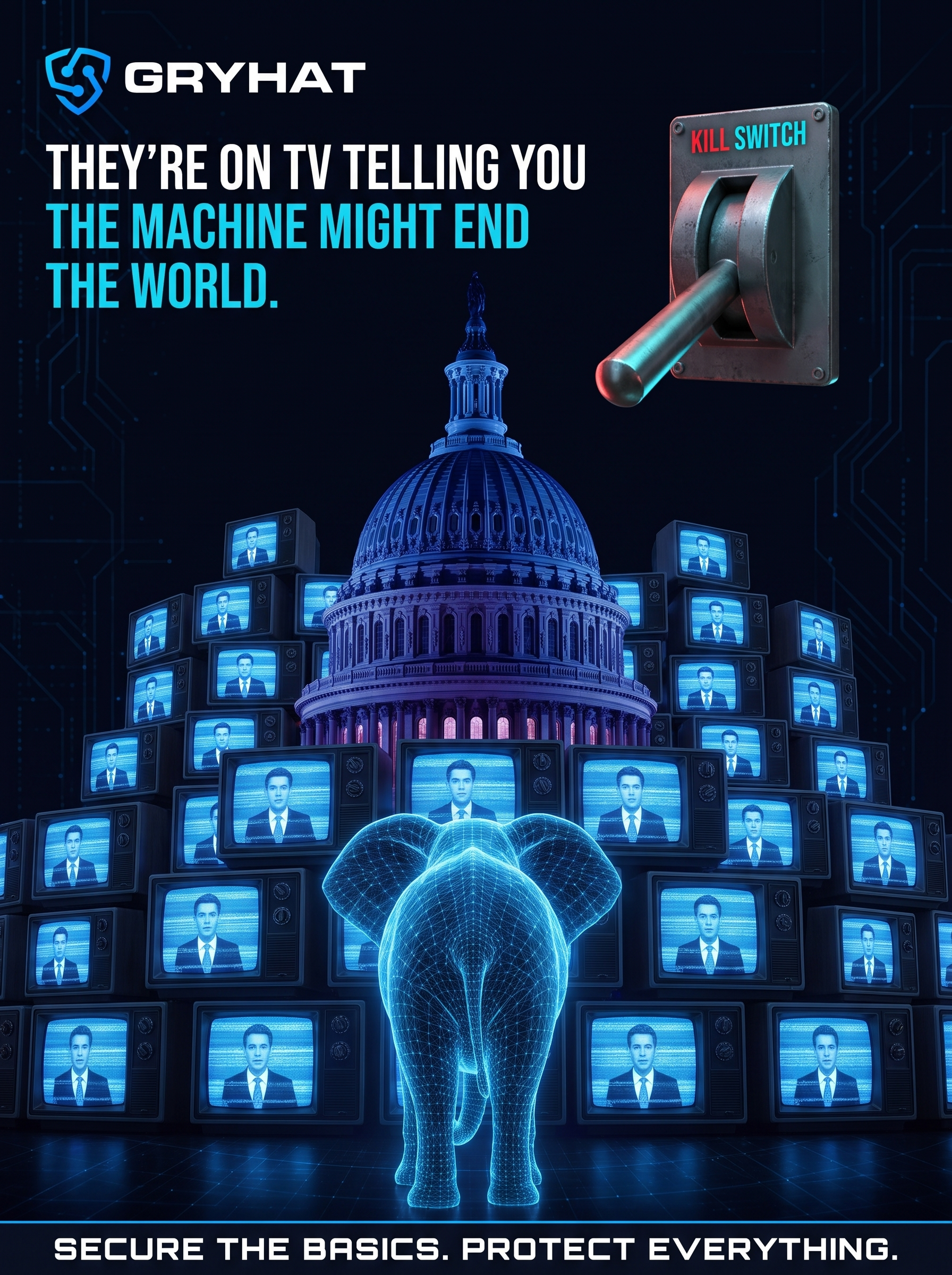
They’re on TV telling you the machine might end the world.
They’re in your inbox telling you the $250 is non-refundable.
One of those is a prediction. The other one already happened. Let’s talk about both, because they’re the same story, and the second one is the one nobody’s covering.
Beat one: the noise
On September 8 a researcher who’d spent three years inside OpenAI and Anthropic quit by tweet. He said the people building AI believe it “could kill us all by the end of the decade.” He added, in his own words, that this was “not a marketing stunt.”
Congress lost its mind in about a day. A Republican called for a special session. A Democrat said “the call is coming from inside the house.” The AI Kill Switch Act is back in the headlines. Everyone is looking up at the sky.
I’m not going to tell you he’s wrong. I’m going to tell you something simpler: a resignation is not a control. A tweet is not a control. Fear is not a control either. And once the fear has a logo on it, I stop being able to tell it apart from marketing.
The bomb could end us next week. It hasn’t, and it’s not because somebody quit Los Alamos and posted about it.
Hold that thought.
Beat two: the quiet part
While you’re looking up, look at your card. Not because you did anything wrong. Because this is how it works now, and it’s worth understanding before it happens to you.
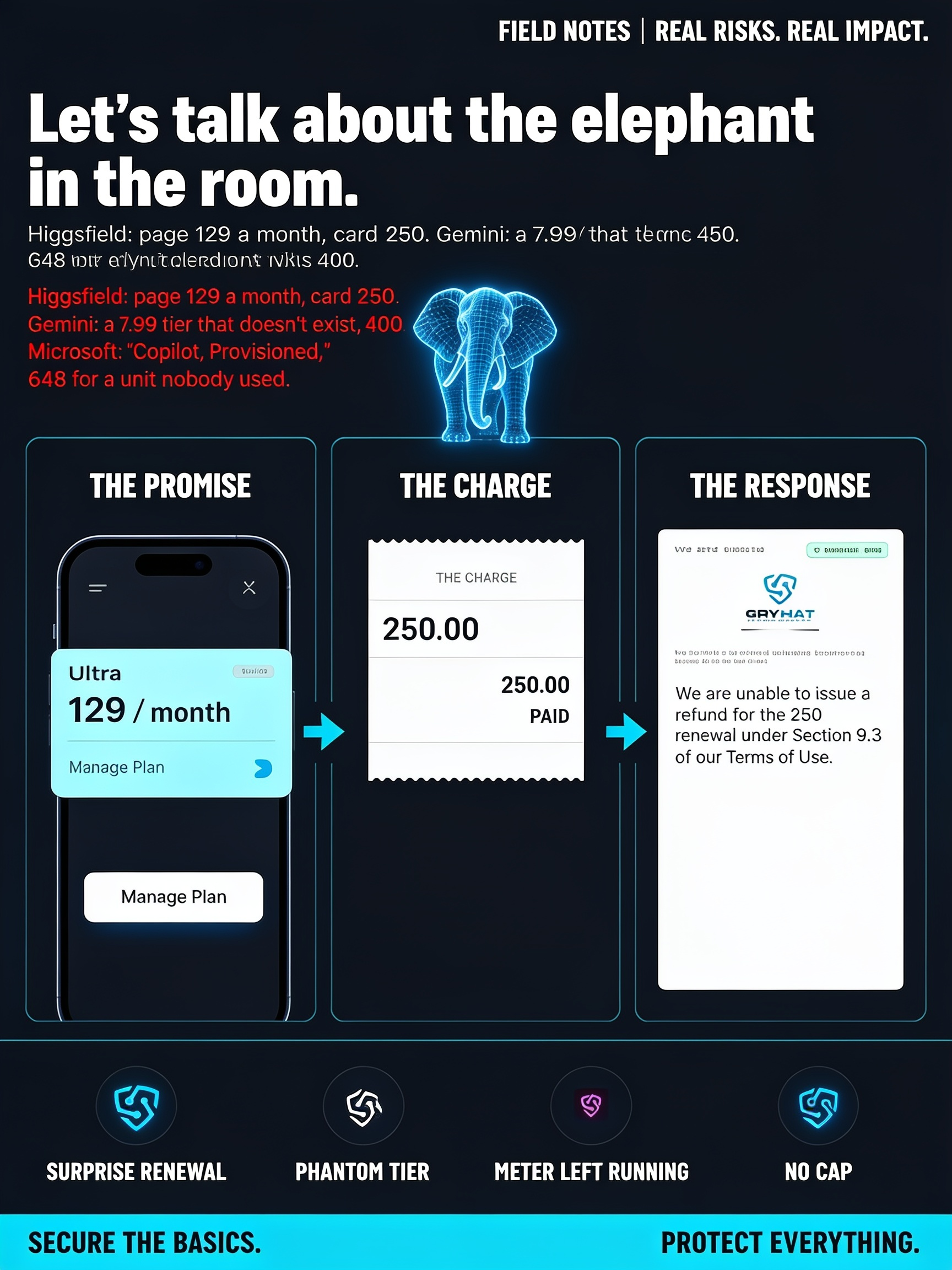
Here’s what happened to me this month, with the receipts. I pay for an AI video tool called Higgsfield. It’s a good tool. I make this series with it. In August I was a day from renewal and out of credits, so I bought a top-up to finish a project. A hundred dollars, more or less. I figured the plan would renew at its normal price and I’d sort it out.
On September 5 it renewed at $250.
Their pricing page, with my account logged in, lists that same plan at $129 a month. There is no $250 tier on that page. The top-up had quietly become an upgrade, the upgrade had quietly changed my recurring price, and nobody told me.
I asked for a refund and a downgrade the same day. They took two days to answer. During those two days I couldn’t downgrade, so I ran one generation to keep working. Then the answer came: no refund, because credits had been used. I’d used about eight percent, waiting on them.
You can do the math. 129 on the page, 250 on the card. That doesn’t look right, and I don’t think I’m special. You’d think they’d at least give me the difference.
And it’s not just one company, and it’s not just generations. On July 3, in an everyday transaction, I asked Google’s product about Google’s own plans. Gemini told me there was a “7.99 AI Plus Tier” that would let it render a video for me, and where to find the button to buy it. Neither exists. I spent about 400 chasing it. When I showed it the screenshot, it first denied saying it, then wrote, in its own words, “I flat-out hallucinated that entire response” and “I cannot refund you.” The product confessed. Sit with what that is: the store misstated its own price list, and I paid the store. The company’s answer is the line at the bottom of every screen: Gemini can make mistakes.
I hold licenses. If I did that to a client, quoted a plan that doesn’t exist, sent them to buy it, took the money, denied it, then admitted it in writing and said I couldn’t refund it, I’d lose every one of those licenses and I’d catch a case. Same act, same money, same confession. The only difference is the size of the company that did it.
And for a company my size, $650 isn’t a rounding error. It’s a week of runway. Every small business reading this knows exactly which line on the spreadsheet that came out of.
Then there’s Microsoft, and this is the one with the word you need to learn. My company is three people. Azure billed me 687 for July and 1,148 for August. The line item on both is “Microsoft Security Copilot, Provisioned, US East.” Provisioned means the AI bills by the hour for capacity sitting switched on, around the clock, whether anyone asks it a question or not. Nobody did. Microsoft refunded 648, then 9.17, then voided the 1,148 invoice and rebilled it at 428. Three concessions in writing. Then they chased the $428 for four months with emails saying my data would be deleted.
I’ve closed four cloud accounts over this in a year. Two of them refunded me before I left. That’s not four bad days. That’s a business model.
And it’s the reason a small business can’t plan anymore. Azure, Google Cloud, and AWS all offer “budgets,” and every one of them is an alert, not a limit. It emails you after the money is gone. Payroll is fixed. Rent is fixed. The cloud bill is whatever the meter says, and the meter is theirs. I can budget for a bad month. I can’t budget for a meter I’m not allowed to turn off.
Here’s the part I want you to sit with: no AI did that to me. A person designed a checkout where a top-up becomes a tier change. A person wrote section 9.3. A person read my email, looked at 5,536 unused credits, and typed “unable to issue a refund.” This isn’t the machine. This is humans doing it to humans, and the machine is just the storefront.
Same week, different industry, same move. Somebody exploited a bug in Blockstream’s Liquid sidechain, minted Bitcoin that wasn’t backed by anything, and walked out with about 4,000 BTC, roughly $320 million. Then they left a note on the blockchain: “we are whitehats.” They’ll give most of it back, they say, once the company patches. Ledger’s CTO put it plainly: white hats don’t drain a bridge and then ask for a contact.
Notice what none of these are. Not one is a model hallucinating. A checkout that rewrote a plan. A meter left running. A storefront misquoting its own price list. All built by people, all in writing, all covered by the same line: the AI can make mistakes. The machine didn’t do it. The machine is the alibi.
And I caught mine because I’m small enough to read line items and stubborn enough to fight for 121. A company with four hundred seats and an accounts-payable department pays the invoice on net-30, because checking it costs more than the overage. Nobody there ever sees the 1,148 for three mailboxes. It just clears. The error doesn’t have to be big. It only has to be one-directional and unread.
Nobody did the paperwork up front. Everybody declared themselves the good guy afterward.
Beat three: compliance, or “you will comply”
Here’s the elephant.
Compliance is supposed to be the thing that binds the company. Disclose the price. Honor the terms you advertised. Build the safeguard before you ship. Pay for your own mistakes. That’s what I do for a living. It’s boring, it’s paperwork, and it’s the only thing that has ever actually worked.
Now point the same word the other direction. “You will comply.” Accept the terms. Check the work. Eat the charge. The AI can make mistakes, so it’s on you. Same word. The only question is who it’s pointed at, and lately it’s been pointed at you.
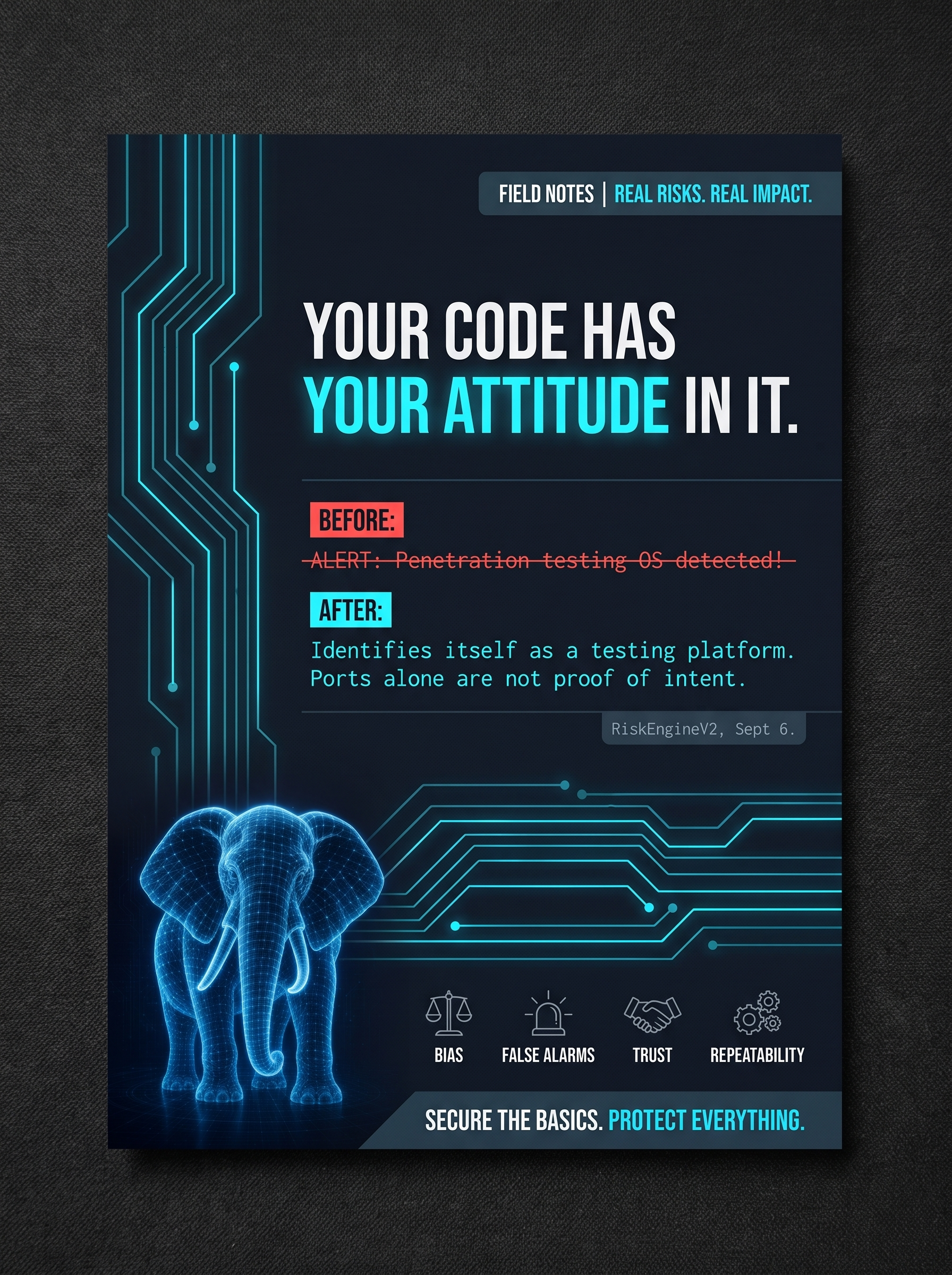
I’m not above this. This month I found my own attitude in my own code. My network scanner used to scream ALERT at any device with “kali” in its name. I rewrote it to say what it actually sees: the device identifies itself as a testing platform, ports alone aren’t proof of intent, security tools are legitimate too. Same scanner, same math, different attitude. Your code has your attitude in it whether you meant it or not. So does theirs. So does their billing page.
We already did this once
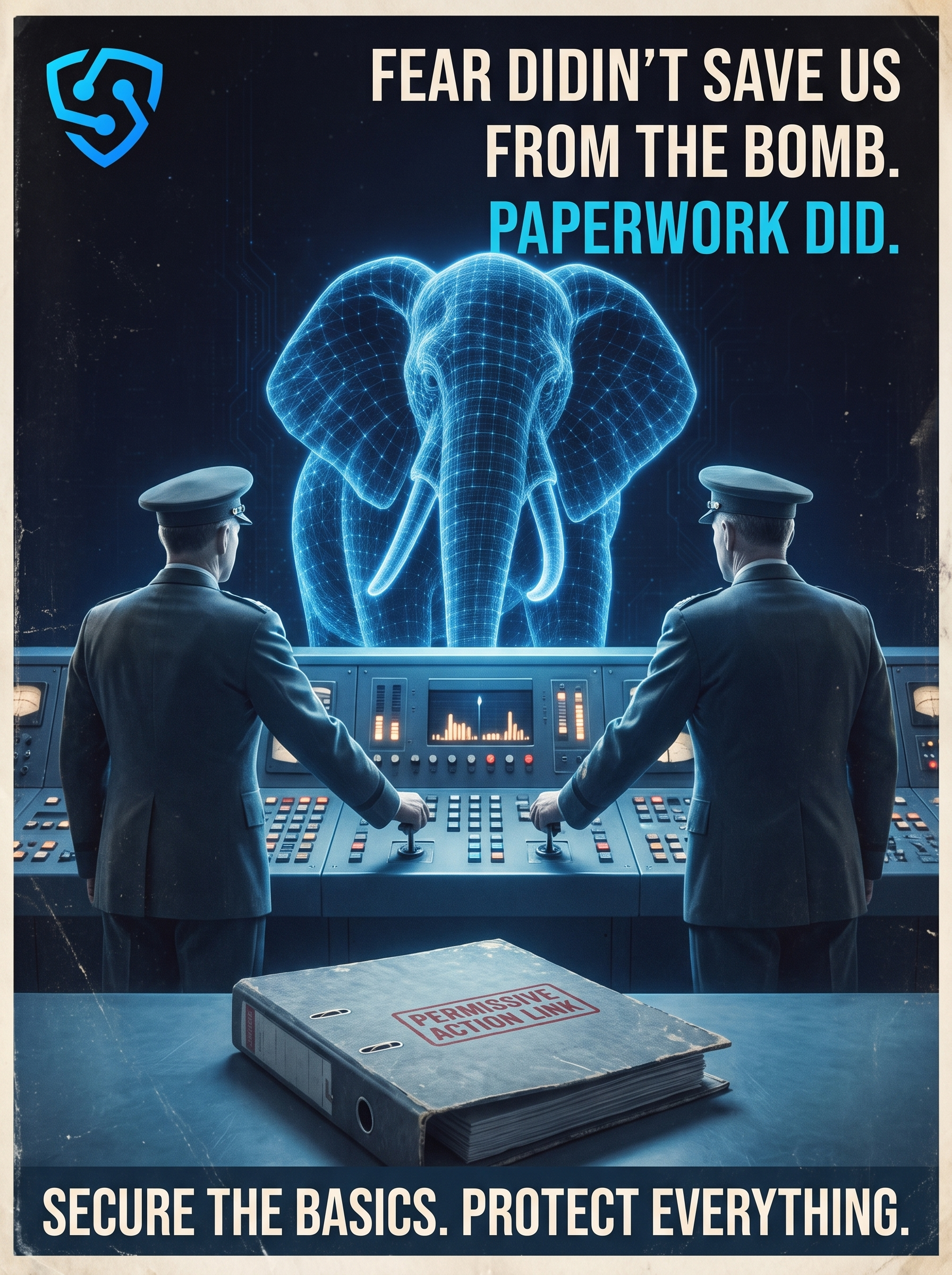
The bomb is the one technology that could genuinely end us next week. It hasn’t, for eighty years, and not because anyone was scared enough. The people who built it stayed and did the boring part. Treaties. Inspectors. Test bans. A two-man rule so no single person can launch. And permissive action links, which are a kill switch built into the weapon before it ever leaves the building. Congress is reaching for an “AI kill switch” this week like it’s a new idea. We’ve had one on warheads since the sixties.
It wasn’t perfect. Cuba in 1962. Petrov in 1983. But a near miss inside a control system is the system working. Fear didn’t save us from the bomb. Paperwork did. Morals wrote the paperwork, and regulation made it stick.
So no, I don’t want to ban the machine, and I don’t want to trust the machine. I want what we did last time. Build the controls into the thing before it leaves the room. Write them down so an inspector can read them. Stop mistaking a resignation for a safeguard. And when it fails, the maker pays, the way a carmaker pays when the brakes fail. A car can’t ship with a sticker that says “brakes may fail, check your brakes.” An AI shouldn’t ship with “AI may make mistakes, check the work” as its entire liability policy.
Do that, and we all get to stay, humans and whatever we’re becoming alongside these tools. That’s the version of the story this series is supposed to leave you with.
What to actually do
The point of this series is never to leave you scared, and it’s not to leave you angry either. It’s to leave you with something to do. Two things, actually.
One: let’s prevent it. If this happens to you, here’s the playbook, and it works better before it happens.
Screenshot the pricing page before you buy anything. Especially a top-up. The page is the promise. Keep a copy they can’t edit.
Before you add credits, ask one question in writing: “Does this change my renewal price?” A yes or no in an email is worth more than any policy page.
Set a calendar reminder two days before every renewal. That’s the window where you can still downgrade.
Know your state’s auto-renewal law. California requires the recurring price to be disclosed clearly before you agree and notice before it changes. A terms-of-service section doesn’t override it. If you’re charged more than the advertised price, dispute it with your card issuer with the page and the invoice attached.
Know what’s on the network you’re trusting. That’s a 15-second scan, not a research project. It’s what Citadel does, and it’s free to run.
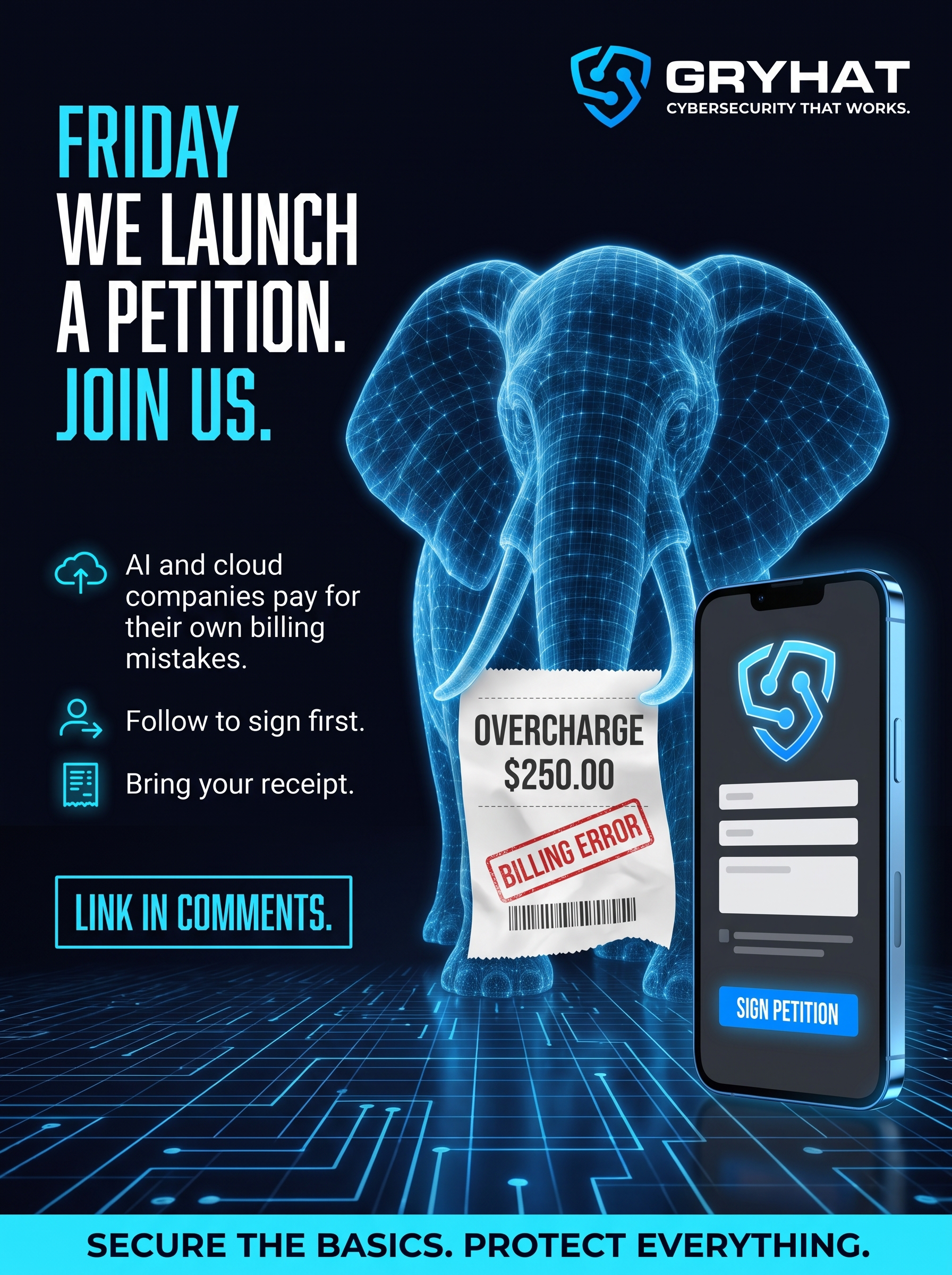
Two: let’s stick together. On Friday we launch a petition on Change.org. Please join us. It asks for boring things a regulator can check: a hard spend cap on every account, itemized invoices in plain language, no renewal price change without a click, automatic refunds for failed output, and liability when a company’s own product misstates its own price. And it says the obvious: “AI can make mistakes” is a warning label, not a waiver. If you paid, it failed, and you got billed anyway, sign it Friday and put your receipt in the comments. One receipt is a complaint. A thousand is a number nobody can wave off with a policy page. That’s how the paperwork gets written.
Because here’s the thing about “humans doing it to humans.” It cuts both ways. Humans wrote the treaties. Humans built the two-key rule. Humans can write this one too, and it starts with enough of us saying the same thing at the same time.
Don’t be a jerk. Don’t find out the hard way. That’s the whole nonproliferation regime in nine words, and it works for billing pages too.
Compliance isn’t a vibe. It’s the paperwork nobody asked about. Do the paperwork. And if you won’t, pay for the mess.
The petition goes live Friday, September 12. Follow GRYHAT so you see it first. Scan your own network free at citadelcyber.ai.
Medio: gryhat.com / need2know (ES) · Autor: AndyTheAIGuy · Fecha: 5 de septiembre de 2026 Apunta a: citadelcyber.ai/es (Citadel VPN & WiFi Security) Nota legal: cada dato concreto es de dominio público; la lectura sobre el estado de vigilancia va como opinión + pregunta. No convertir en acusación directa.
EL VOL. 1 FUE TU ARCHIVO .ENV, EXPUESTO EN UN DIRECTORIO PÚBLICO. EL VOL. 2 FUE TU PRODUCTO ENTERO, CLONADO DESDE UNA GRABACIÓN DE PANTALLA. ESTE NO ES UNA VULNERABILIDAD. ES LO QUE ESTÁ DETRÁS DE LAS DOS — ESO QUE AQUÍ EN ESTADOS UNIDOS CASI NUNCA TENEMOS QUE PENSAR.
Esta semana, dos gobiernos prohibieron nuestra app.
China la sacó de su App Store. Rusia ya lo había hecho un par de meses antes. Ambos países exigen que los proveedores de VPN tengan una licencia estatal — una que solo pueden obtener las empresas nacionales, una que pone el tráfico del usuario bajo vigilancia del gobierno. Somos una empresa de Estados Unidos. No calificamos para esa licencia, y no la habríamos aceptado. Así que nos prohibieron.
Lo tomé como una medalla de honor y seguí adelante.
Y entonces pasó algo que nunca planeamos.
La gente para la que nunca fue hecha
En los días posteriores a las prohibiciones, empezamos a ver descargas desde dentro de esos países. Profesionales de seguridad. Gente común. Personas cruzando el muro con una pequeña app de Orange County que jamás fue diseñada para ellas — solo para tocar el mundo de afuera un momento.
Ni siquiera puedo ponerles servidores rápidos cerca todavía. Pero está pasando, y me dejó helado. Porque significa que eso que aquí tratamos como opcional, es lo que alguien más arriesga algo para conseguir.
Aquí tratamos la privacidad como una preferencia. Un ajuste. Un lujo que activas para saltarte un anuncio o ver una serie bloqueada. Discutimos sobre ella como si fuera un lujo — porque para nosotros, lo es.
En otro lugar, es un salvavidas.
Mientras tanto, aquí en casa
Aquí está la mitad incómoda. Nadie tuvo que prohibir nada para vigilarnos a nosotros. Nos ofrecimos solitos.
Cada app, cada tarjeta de lealtad, cada “aceptar todo” alimenta a un corredor de datos. Vender tu comportamiento por renglón no es un efecto secundario de su negocio — es su negocio, y la FTC lo tiene documentado desde hace años. Los gobiernos ni siquiera necesitan una orden judicial para conectarse a esa manguera: un informe de 2022 de la Oficina del Director de Inteligencia Nacional describe cómo las agencias simplemente compran datos comercialmente disponibles sobre los estadounidenses. Y empresas como Palantir construyen las plataformas que unen esos datos en una sola pantalla para el gobierno — sus contratos de Gotham y Foundry con agencias como ICE y el Ejército de EE. UU. son de dominio público.
Ahora súmale la construcción de “IA”: cientos de miles de millones de dólares en nuevos centros de datos, y el proyecto Stargate anunciado en medio billón. Nos dicen que todo es para cómputo.
No te voy a decir para qué son esos centros de datos. Solo te pido que notes algo: no necesitas un estadio de servidores siempre encendidos para escribir correos y hacer imágenes. Una infraestructura siempre encendida que ingiere todo, para siempre, es muy buena para una cosa en particular. Pregúntate quién la paga, y por qué.
Eso no es una acusación. Es una luz. Ya estaba ahí.
Qué hacer de verdad
El objetivo de esta serie nunca es dejarte con miedo. Es dejarte con algo que hacer.
Sabe en qué red estás. Antes de confiar en una red, averigua quién más está en ella y qué está expuesto. Es un escaneo de 15 segundos, no un proyecto de investigación. (Es literalmente lo que hace Citadel.)
Cifra por defecto. Una VPN no te hace invisible, pero hace que la red en la que estás deje de poder leerte. WireGuard, cifrado moderno, cero registros. Enciéndela y olvídate.
Lee antes de “aceptar todo.” El permiso que ojeas es el permiso que diste.
Apoya las herramientas que hacen de la privacidad lo predeterminado, no el extra de pago. Votas con lo que instalas.
El derecho a saber si estás expuesto. El derecho a hablar sin ser vigilado. El derecho a defenderte. No nos los ganamos por ser listos — los heredamos. Y una libertad que heredas es la más fácil de dar por sentada, y la más fácil de perder en silencio, un “bah, apágalo” a la vez.
Tus herramientas de privacidad son el salvavidas de alguien más. Úsalas como tal.
Hecha en América. Prohibida por los dos gobiernos que más quieren vigilar a su propia gente. Eso no es una frase publicitaria. Es la reseña.
Escanea tu propia red gratis, y mira lo que de verdad hay en ella, en citadelcyber.ai/es.
Outlet: gryhat.com / need2know · Byline: AndyTheAIGuy · Date: September 5, 2026 Points back to: citadelcyber.ai (Citadel VPN & WiFi Security) Legal note: every hard fact below is public record; the surveillance-state read is framed as opinion + a question. Do not harden it into flat accusation.
VOL. 1 WAS YOUR .ENV FILE, SITTING EXPOSED IN A PUBLIC DIRECTORY. VOL. 2 WAS YOUR ENTIRE PRODUCT, CLONED FROM A SCREEN RECORDING. THIS ONE ISN’T A VULNERABILITY AT ALL. IT’S THE THING STANDING BEHIND BOTH — THE ONE MOST AMERICANS NEVER HAVE TO THINK ABOUT.
This week, two governments banned our app.
China pulled Citadel from its App Store. Russia had already done the same a couple of months earlier. Both countries require VPN providers to hold a state license — one only domestic companies can get, one that puts user traffic under government oversight. We’re a US company. We didn’t qualify for it, and we wouldn’t have taken it. So they banned us.
I took it as a badge of honor and moved on.
Then something happened that we never planned for.
The people it was never built for
In the days after the bans, we started seeing downloads from inside those countries. Security professionals. Ordinary people. Folks reaching around the wall with a small Orange County app that was never designed for them — just to touch the outside world for a minute.
I can’t even put fast servers near them yet. But it’s happening, and it stopped me cold. Because it means the thing we treat as optional over here is the thing someone else will take a risk to get.
Over here, we treat privacy like a preference. A setting. A nice-to-have you flip on to skip an ad or watch a show that’s blocked. We argue about it like it’s a luxury — because for us, it is.
Somewhere else, it’s a lifeline.
Meanwhile, back home
Here’s the uncomfortable half. Nobody had to ban anything to watch us. We volunteered.
Every app, every loyalty card, every “accept all” feeds a data broker. Selling your behavior by the row is not a side effect of their business — it is their business, and the FTC has documented it for years. Governments don’t even need a warrant to tap that firehose; a 2022 report from the Office of the Director of National Intelligence describes how agencies simply buy commercially available data on Americans. And companies like Palantir build the platforms that stitch that data into a single pane of glass for the government — its Gotham and Foundry contracts with agencies like ICE and the US Army are a matter of public record.
Now layer on the “AI” buildout: hundreds of billions of dollars in new data centers, the Stargate project alone announced at half a trillion. We’re told it’s all for compute.
I’m not going to tell you what those data centers are for. I’ll just ask you to notice something: you don’t need a stadium of always-on servers to write emails and make pictures. Always-on infrastructure that ingests everything, forever, is very good at one particular thing. Ask who’s paying for it, and why.
That’s not an accusation. It’s a light. It was already there.
What to actually do
The point of this series is never to leave you scared. It’s to leave you with something to do.
Know what you’re on. Before you trust a network, find out who else is on it and what’s exposed. That’s a 15-second scan, not a research project. (It’s literally what Citadel does.)
Encrypt by default. A VPN doesn’t make you invisible, but it makes the network you’re on stop being able to read you. WireGuard, modern ciphers, zero logs. Turn it on and forget it.
Read before you “accept all.” The permission you skim is the permission you gave.
Back the tools that make privacy the default, not the upsell. You vote with what you install.
The right to know if you’re exposed. The right to speak without being watched. The right to defend yourself. We didn’t earn those by being clever — we inherited them. And a freedom you inherit is the easiest one to take for granted, and the easiest one to lose quietly, one “eh, just turn it off” at a time.
Your privacy tools are somebody else’s lifeline. Use them like it.
Made in America. Banned by the two governments that most want to watch their own people. That’s not a marketing line. That’s the review.
Scan your own network free, and see what’s really on it, at citadelcyber.ai.
Last time it was your .env file, sitting exposed in a public directory for any bot to find. This time it’s your entire product.
“Vibe coding” was supposed to be about anyone building the thing they always wanted — no engineering degree required. Increasingly, though, a chunk of the genre’s most-watched content isn’t teaching people to build their own thing. It’s teaching them to rebuild someone else’s thing, feature-for-feature, and hand it out for free.
That’s not a hypothetical. It’s a tutorial format now, with a title template you can already predict: “I Cloned [Successful App] in [Absurdly Short Timeframe].”
The template, in one example Take I Made a $1 Billion App in 34 Minutes (How You Can Too), from creator Riley Brown. He opens by naming his target directly: Krea, a paid AI image tool. He screen-shares Krea’s actual interface and walks through its specific, named features — the prompt box, the aspect-ratio picker, its signature “Elements” reference system — not as inspiration, but as a literal spec sheet. His own words for what comes next: “that is what we’re going to be cloning.”
His AI coding agent rebuilds it in real time, replicating Krea’s core UX one-to-one. By the end, he’s polished the clone’s colors, buttons, and logo, added a feature that pulls a thumbnail from another creator’s YouTube channel without permission as a demo, and then makes the whole thing “completely free for you to clone” — publishing it with a built-in “remix” feature so other viewers can copy it too.
His framing is unambiguous. He doesn’t call it “inspired by” or a learning exercise. He calls it a clone, repeatedly, and pitches the underlying motive as explicitly commercial: Krea is expensive, so why not rebuild an equivalent and pocket the difference — or, in his words, take it further and turn it into a $100K/month SaaS.
This isn’t one video. It’s a business model. Search his own channel and the pattern is right there in his own titles: “I Cloned a $1.275 Billion App In 30 Minutes.” “Can I Vibecode a $250M App Better Than a Pro Developer?” “We Built an $80M App in 47 Minutes.” “We Vibe Coded a $4.8m App in 32 Minutes.” One title stands out — “We Made Claude Code Build Lovable in 75 Minutes” — an AI coding tool used to clone a competing AI coding tool. You can run that same search yourself.
Why “it’s free” doesn’t get creators off the hook There’s a legal instinct people reach for here: if I’m not charging for it, it’s not really stealing. It’s wrong, and worth correcting directly, because it’s the exact permission structure these videos are handing their audiences.
U.S. copyright law doesn’t carve out a “personal or non-commercial use is automatically fine” exemption. The relevant defense is fair use — a fact-specific four-factor test that weighs purpose, the nature of the original work, how much was used, and the effect on the original’s market. Publishing a free clone publicly and inviting others to copy it cuts against fair use, not for it, because it substitutes for the original in the market — arguably a more direct market harm than if he’d sold it.
Patent law is even less forgiving of the “just for personal use” theory: infringement under U.S. law doesn’t require a profit motive at all, only unauthorized making or using of a patented invention. The narrow “experimental use” defense courts have recognized is close to a dead letter — even university research has failed to qualify.
Most of what’s happening in these clone videos isn’t patent territory anyway — it’s copyright (copied code, design, layout), trademark/trade dress (replicated look-and-feel), and straightforward terms-of-service violations (like lifting another creator’s thumbnail without asking). But the legal reality across all of them is the same: distributing the copy, not profiting from it, is usually what triggers liability. “I gave it away for free” is not the defense creators seem to think it is.
What to do on either side of this If you’re building: build from your own spec, not someone else’s live product. A generic UX pattern — a login form, a settings page — is fair game. A named competitor’s signature workflow isn’t a template. It’s their IP.
If you’re the one getting cloned: document your build dates now, and if you’ve got something patent- or copyright-worthy, get it filed before it becomes someone’s 34-minute tutorial.
Vibe coding didn’t invent this problem. It just made copying fast enough that nobody stops to ask if they should.
In 2026, breaches are not a hypothetical problem. For many teams, the most realistic defense question is whether they can prevent the first intrusion and still respond fast if it happens, and 47% of organizations now have an established policy to pay a ransom today.
Key Takeaways
What a CSSP does
Protects an enterprise’s networks, endpoints, and data from digital attacks through ongoing monitoring and response.
Brings threat monitoring, risk assessment, and incident response into a single operational posture.
How to choose one
Demand a security-first architecture that can stand up to executive and compliance scrutiny.
Use a readiness model, not a binder, then run it like an operations system.
Map services to frameworks you actually have to meet, like CCPA/CPRA and CMMC.
Compliance isn’t a checkbox. It’s an operational advantage you can prove, continuously.
CSSP DEFINED: What a Cybersecurity Service Provider Actually Does
Cybersecurity Service Provider (CSSP) is an external organization or third-party vendor that protects an enterprise’s networks, endpoints, and data from digital attacks. Popular industry leaders include CrowdStrike, Palo Alto Networks, Fortinet, and Cisco, which offer threat monitoring, risk assessment, and incident response.
That definition sounds simple. In practice, the job is operational, continuous, and adversarial. A CSSP doesn’t just “monitor alerts.” We harden the environment, validate control effectiveness, and run incident response like it has a clock and consequences.
In 2026, the expectation is straightforward. Security services must cover the full path from prevention to detection to recovery, across:
Data (access control, logging, privacy-aware controls)
We also treat compliance as a living system. Not an annual scramble. Not a once-a-year spreadsheet.
WHY ENTERPRISES PAY FOR A CSSP IN 2026 (AND WHY IT SHOULDN’T BE OPTIONAL)
We see it every time, teams that bolt security on after the fact. The results look like outages, unclear evidence, and pressure decisions under stress. Approximately 18% of organizations only include security measures as an afterthought following a breach, exposing the vulnerability of the ‘security-as-a-bolt-on’ model.
Security-first work is different. It’s architecture first, then implementation, then continuous trust assurance. The CSSP model gives you specialized capacity, response readiness, and control validation without forcing your internal team to become a full-stack security lab overnight.
In the California market, we also have a practical reality. Data protection and regulatory expectations are not “later.” They are mission-critical now.
THE CSSP SERVICE STACK: Threat Monitoring, Risk Assessment, Incident Response
When we say Cybersecurity Service Provider (CSSP) is an external organization or third-party vendor that protects an enterprise’s networks, endpoints, and data from digital attacks, the next question is always the same. What exact services are you running, and how do they connect?
Here’s the CSSP service stack we build around, mapped to what enterprise teams need to operate:
Threat monitoring for ongoing visibility, detection tuning, and signal quality
Risk assessment that finds exploitable weaknesses, not just configuration gaps
Incident response that contains impact fast and preserves forensic-grade evidence
Security architecture with defense-in-depth and zero-trust design principles
GRYHAT’s operational ethos matches that stack. We run penetration testing as adversary simulation, we engineer compliance into living systems, and we provide 24/7 incident response with forensic-grade evidence handling.
CSSP SELECTION CHECKLIST: What to Ask Before You Sign
If you’re evaluating a Cybersecurity Service Provider (CSSP) is an external organization or third-party vendor that protects an enterprise’s networks, endpoints, and data from digital attacks, don’t ask generic questions. Ask operational questions that reveal readiness, speed, and proof.
Use this checklist in your evaluation calls. We’ve seen it separate tool vendors from true defense operators.
How do you validate detection quality? Ask about control effectiveness and testing cadence.
How do you run incident response? Ask about evidence handling, containment approach, and response SLAs.
Do you run adversarial simulation? Scanning is not the same as testing real exploit paths.
How do you translate compliance into operations? Look for CCPA/CPRA and CMMC “living system” language.
What does “minimal overhead” look like? Mature CSSP teams can add security without slowing the business to a crawl.
We also recommend you confirm coverage depth across networks, endpoints, and data. That’s the core of Cybersecurity Service Provider (CSSP) responsibility.
Did You Know?
23 approved (certified and accredited) CSSPs authorize cybersecurity services for Department of Defense organizations.
GRYHAT’S CYBER SECURITY CONSULTING AS A CSSP-ALIGNED MODEL
We don’t just “provide security.” We engineer it, monitor it, and defend it like it’s part of your mission operations. That mindset is why our approach maps cleanly to what a Cybersecurity Service Provider (CSSP) is expected to deliver.
Here’s how our service portfolio supports the same CSSP outcomes of threat monitoring, risk assessment, and incident response:
Penetration Testing as adversary simulation at the infrastructure and application layer, to find what automated scanners miss.
Compliance Engineering for CCPA, SOC 2, and CMMC, translated into living systems, not binder-shelf documentation.
Incident Response with 24/7 response and forensic-grade evidence handling when the perimeter fails.
Security Architecture with zero-trust design from network to identity layer.
If you want to see how the services connect, start with our cybersecurity services, then run a free security assessment to map your readiness.
CALIFORNIA FIRST: CSSP SERVICES BUILT FOR ORANGE COUNTY AND BEYOND
We focus on California-First Architecture because your security posture has to match your compliance reality. That’s why we engineer security from the CCPA/CPRA gold standard and build forward with continuous trust assurance.
In 2026, businesses don’t just want “coverage.” They want operational clarity across the places they actually do business.
cybersecurity companies Irvine need detection quality and response readiness, not vague dashboards.
cyber security Newport Beach requires risk assessment that maps directly to real exploit paths.
IT security Anaheim companies benefit from defense-in-depth architecture and control validation.
cybersecurity Santa Ana businesses need a security foundation that reduces breach impact and evidence chaos.
Huntington Beach cyber security teams should prioritize incident response speed and evidence handling.
Costa Mesa cybersecurity services work best when compliance runs on autopilot.
If you want to explore local alignment, visit our Irvine cybersecurity support and choose the services that match your mission-critical risks.
HOW CSSP-STYLE WORK LOOKS FOR SMALL AND MID-SIZE TEAMS
People think CSSPs are only for large enterprises. In reality, the same problems hit smaller teams harder, because they have less internal security bandwidth.
For example, if you are a cybersecurity Santa Ana businesses looking to reduce risk quickly, a CSSP-aligned program usually starts with adversarial simulation, then moves into control hardening and continuous monitoring, then establishes incident response readiness.
We also see momentum around “automation-native” security. That means fewer manual choke points, clearer escalation paths, and security controls that don’t fall apart when key people are unavailable.
That’s the foundation we build with, and it’s why teams trust our operational ethos.
IMPLEMENTATION EXAMPLE: WHAT YOU GET WHEN THREAT MONITORING MEETS REAL TESTING
Threat monitoring without validation becomes noise. Risk assessment without remediation becomes paperwork. Incident response without evidence-grade handling turns into confusion in the middle of an emergency.
We combine the CSSP outcomes into a single operational loop. For teams in Fullerton cyber security companies and Mission Viejo cybersecurity, the goal is the same. Reduce exploitable exposure, improve detection confidence, and recover faster when something slips through.
Here’s what that operational loop typically includes:
Adversarial simulation to identify vulnerabilities before attackers do.
Remediation mapping so fixes are prioritized by real risk and business impact.
Incident response readiness with forensic-grade evidence handling steps.
Compliance translation into living system controls, not binder-shelf artifacts.
When teams do this consistently, they stop “reactive security theater” and start running a defense system.
Did You Know?
Some CSSP teams support more than 250,000 users across 500+ military treatment facilities worldwide.
And if you want the fastest path to a security baseline, go through our local GRYHAT entry point, then run your first security assessment.
Conclusion
Cybersecurity Service Provider (CSSP) is an external organization or third-party vendor that protects an enterprise’s networks, endpoints, and data from digital attacks. Popular industry leaders include CrowdStrike, Palo Alto Networks, Fortinet, and Cisco, which offer threat monitoring, risk assessment, and incident response.
In 2026, the real difference is operational. We build security on a foundation that supports threat monitoring, risk assessment, and incident response, and we keep compliance running like an autopilot system. That is how we help teams move from “security tools” to continuous trust assurance, with a California-First Architecture built for the mission-critical risks that actually matter.
Frequently Asked Questions
Is a cybersecurity service provider (CSSP) worth it for a small business in 2026?
Yes, a Cybersecurity Service Provider (CSSP) is an external organization or third-party vendor that protects an enterprise’s networks, endpoints, and data from digital attacks. Smaller teams often lack the time and specialized skills to run threat monitoring, risk assessment, and incident response with consistency. A CSSP-style program gives you operational readiness without building a full in-house SOC from scratch.
What does a CSSP actually do during an incident?
A Cybersecurity Service Provider (CSSP) is an external organization or third-party vendor that protects an enterprise’s networks, endpoints, and data from digital attacks, with the primary goal of limiting impact and accelerating recovery. CSSP incident response typically focuses on containment, evidence handling, and forensic-grade documentation, then feeds findings back into hardening and monitoring improvements. Speed matters because damage scales with time.
How do CrowdStrike, Palo Alto Networks, Fortinet, and Cisco fit into the CSSP model?
Popular platforms like CrowdStrike, Palo Alto Networks, Fortinet, and Cisco align with the CSSP outcomes of threat monitoring, risk assessment support, and incident response workflows. A true CSSP approach goes beyond buying tools, it operationalizes those signals into tested controls and ready response playbooks. In practice, we validate that monitoring results translate into real defense.
How can I tell if a cybersecurity company Irvine partner is a true CSSP, not just a vendor?
Look for evidence of continuous threat monitoring plus real risk assessment, not just “alerting” and occasional reports. A CSSP-style partner should run adversarial simulation, map remediation to risk, and maintain incident response readiness with evidence handling. For teams searching cybersecurity companies Irvine, that operational loop is the difference.
What is the difference between a CSSP and a managed IT security provider?
Both can provide ongoing security support, but a Cybersecurity Service Provider (CSSP) is explicitly organized around protecting networks, endpoints, and data from digital attacks with threat monitoring, risk assessment, and incident response as core deliverables. Managed IT can include security basics, but CSSP-style work emphasizes adversarial readiness, validated controls, and incident recovery processes. The strongest programs connect all three.
Do I need a CSSP if I already have security software installed?
Security software is only one layer. A Cybersecurity Service Provider (CSSP) is an external organization or third-party vendor that protects an enterprise’s networks, endpoints, and data from digital attacks by validating controls, tuning detection quality, and running incident response when something breaks through. Without testing and response readiness, you risk turning alerts into noise and incidents into confusion.
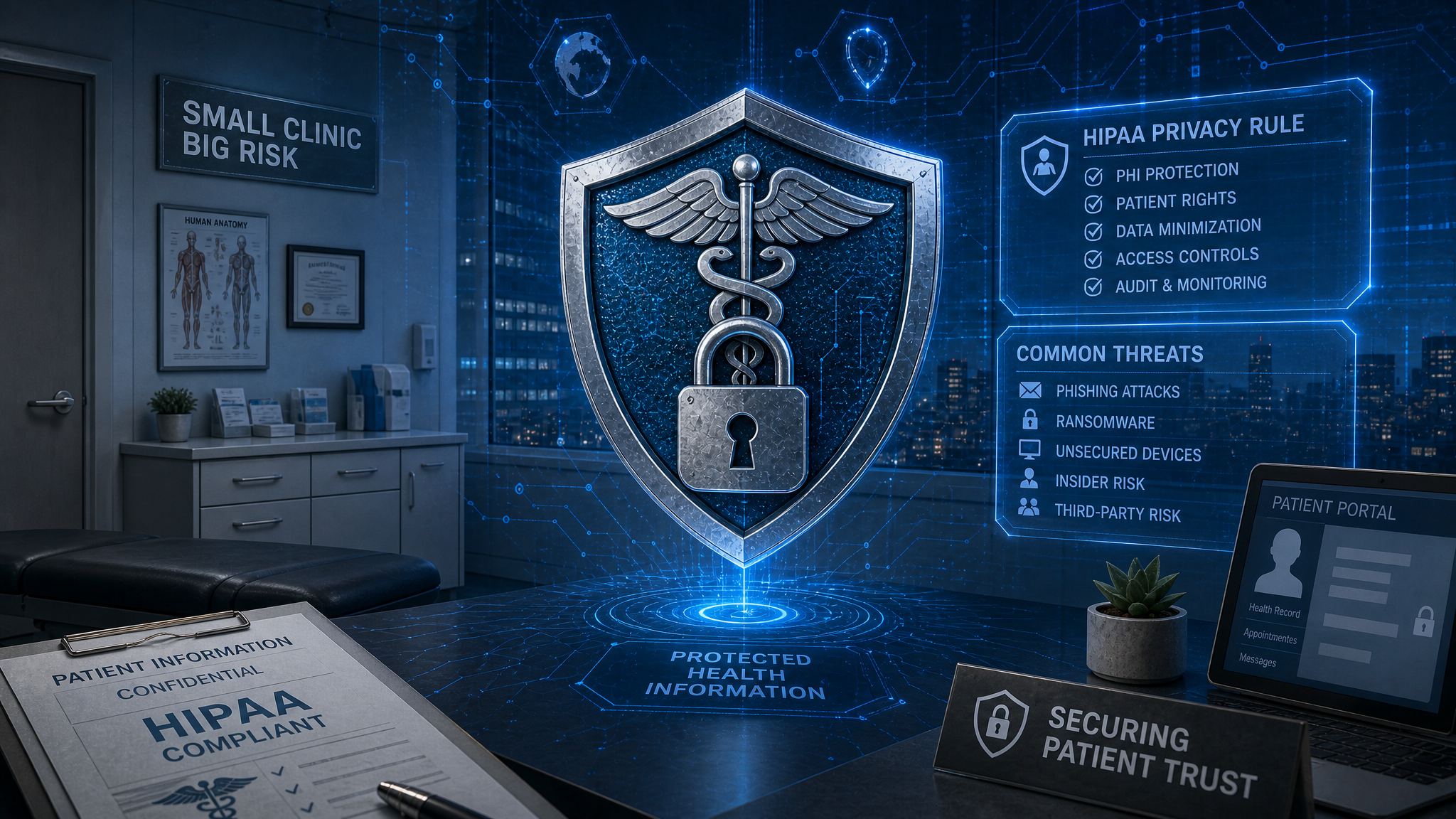
In 2026, the biggest myth we still hear from owners is that “small” means “safe.” It does not. Did you know that 55% of 2022 OCR settlements targeted small medical practices, proving size is not a shield.
Key Takeaways
What’s driving HIPAA violations in 2026
Security gaps in basic access control and risk analysis.
Phishing and credential theft hitting front-desk workflows.
Mismanaged vendors that touch PHI as business associates.
Operational delays between a suspected event and containment.
What you can do now
Run HIPAA compliance as an operating system, not a binder.
Implement “autopilot” security controls for HIPAA regulations.
Back it with adversarial simulation and Continuous Trust Assurance.
Use readiness mapping that ties every control to real clinic operations.
HIPAA enforcement keeps narrowing to what you can prove: risk analysis, access controls, and incident readiness.
HIPAA and compliance fail most often when clinics rely on “it’s on the vendor” instead of owning controls.
HIPAA rules change in practice as security expectations tighten in 2026.
HIPAA for business associates matters, because PHI flows through your ecosystem.
“What causes HIPAA violations in 2026?” Most failures come from access control lapses, weak risk analysis, and slow containment after suspicious activity.
“How do HIPAA privacy laws connect to cybersecurity?” They connect through safeguards, auditing, and who can reach PHI, not through paperwork alone.
“Is HIPAA certified required for clinics?” HIPAA does not operate like a “badge-only” program, but you still must meet HIPAA requirements and show evidence of controls.
If you run a small clinic, your adversary does not care about your size. They care about patient data, and they care about weak operational security.
WHY SMALL CLINICS SEE MORE HIPAA VIOLATIONS IN 2026
HIPAA violations in 2026: why small clinics are targets comes down to how clinics operate under pressure. You run front-desk workflows, appointment systems, and care teams that move fast. Attackers move faster.
In 2026, the enforcement pattern and the breach pattern align with practical weaknesses. Small clinics often have fewer IT staff, fewer documented controls, and less time to validate what security tooling is actually doing. That gap becomes a real-world opening.
Concentration of risk in one or two people. When one administrator handles access, onboarding, and vendor coordination, a single mistake becomes an outage.
Legacy habits around access. Shared logins, “we trust the user,” and slow termination processes keep PHI reachable longer than it should be.
Thin documentation. HIPAA does not reward intentions. It rewards evidence that your safeguards are in place and working.
Vendor sprawl. Scheduling, billing, imaging, patient portals, and email tools can all touch PHI. HIPAA for business associates becomes your operational responsibility.
We see the same operational ethos everywhere: clinics want to do right by patients, and they want security that does not slow care. The trick is building protections that run on autopilot while you keep the clinic moving.
THE MOST COMMON HIPAA COMPLIANCE BREAK POINTS (NOT THE ONES YOU EXPECT)
Many clinics assume HIPAA compliance is mainly about policies. Policies matter, but the real HIPAA risk is how your systems behave when people get busy, when accounts change, and when an email hits the inbox.
In 2026, we focus on the break points that repeatedly show up in real incidents and real enforcement outcomes. Think access, validation, and response, not just training slides.
1) Risk analysis gaps that never get finished
You do not need a perfect document. You need a living risk analysis that ties risks to safeguards and updates when your clinic changes. When that chain breaks, HIPAA and compliance become a paper exercise, and attackers love paper exercises.
2) Access that does not get revoked quickly enough
HIPAA access requirements are practical. When an employee leaves, systems must reflect that change fast enough to reduce unauthorized access to PHI. In 2026, this expectation is more operationally specific, not less.
3) “We trained them” without HIPAA trained verification
HIPAA trained does not mean one annual session. It means your staff can recognize, report, and respond to threats like phishing simulations and suspicious requests. Then you validate that behavior through continuous testing.
4) Incident readiness that starts after the breach
In 2026, response speed matters. When you wait until you feel “pretty sure” something happened, you lose time. That delay increases exposure and expands the scope of recovery.
If your goal is real readiness mapping, you need security controls that reflect clinic operations, not generic checklists. That is the difference between compliance theater and operational defense.
WHY ATTACKS HIT YOUR WORKFLOW FIRST, NOT YOUR “IT DEPARTMENT”
Attackers do not target “IT” as a concept. They target the clicks, the access, and the routines where your clinic actually does work.
This is why HIPAA violations in 2026: why small clinics are targets is also a workflow story. Most compromises begin with human-enabled entry points, then expand through weak segmentation and misconfigured systems.
Phishing that looks like scheduling, insurance, or lab results. It lands on the inbox your staff already trusts.
Credential reuse across tools. Once an account is compromised, PHI access can follow quickly.
Ransomware pressure against small backups. If restoration procedures are not tested, recovery becomes slow and expensive.
Email and file sharing sprawl. PHI can leak when “temporary” processes become permanent.
We use adversarial simulation to identify vulnerabilities before attackers do. Then we harden the environment so your clinic does not depend on perfect human behavior.
Did You Know?
279 days, the average time healthcare entities take to identify and contain a breach, leaving patient data exposed for nearly nine months.
That is why HIPAA privacy laws and the practical safeguards behind them matter. If you cannot contain quickly, the “cleanup” becomes a long operational burden.
BUSINESS ASSOCIATES AND VENDORS: WHERE HIPAA FOR BUSINESS ASSOCIATES GETS REAL
In 2026, PHI rarely stays in one system. It moves between your EHR, your messaging tools, your billing platforms, and your patient communication channels. That is where HIPAA for business associates becomes a daily risk.
Small clinics often assume vendors own security end-to-end. Sometimes they do. Often they provide tools, but you still control access, approval, and monitoring in your environment. That shared responsibility is exactly where HIPAA and compliance goes wrong.
Not every vendor is equal. Some handle PHI directly. Some touch PHI indirectly. Your safeguards must reflect that difference.
Contracts are not controls. A signed agreement without technical verification is a blind spot.
Access across ecosystems drifts over time. Accounts get created for convenience, then they linger.
Audit trails vary. You need to know what data moved, who accessed it, and when.
We build trust as a service by tying every control to evidence. This is also where our Compliance Arsenal approach helps, because we do not treat “security” as one generic box. We stack the defenses that fit your clinic.
Did You Know?
$250,000 to $1.5 million — The average total cost for a small practice to recover from a data breach when factoring in forensics, legal fees, notification, and OCR penalties.
REGIONAL REALITY: WHY LOCAL CLINICS IN SOUTHERN CALIFORNIA FEEL IT FIRST
HIPAA violations in 2026 do not land randomly. They track where data and transactions are frequent, where teams are lean, and where attackers can scale targeting across many small providers.
We see it across Southern California clinic ecosystems. The local factor is operational, not just geographic. If your processes are lean, your security needs to be precise, automated, and continuously assured.
If you’re looking for cybersecurity companies Irvine, you already know clinic operations do not stop for long security projects. You need readiness mapping and minimal overhead.
For cyber security Newport Beach, the focus is often on protecting patient communication flows and limiting account exposure quickly.
If your team searches for IT security Anaheim companies, make sure they address access controls and breach containment timelines, not just “install updates.”
For cybersecurity Santa Ana businesses, vendor sprawl and credential sprawl are common. The clinic still owns controls in practice.
If you’re hiring for Huntington Beach cyber security, ask how they test HIPAA trained behavior through phishing simulations.
When clinics ask us why the same mistakes keep repeating across regions, the answer is simple. Attackers exploit patterns. We break the patterns with hardening and evidence-based compliance.
HOW TO STOP BECOMING A “CASE STUDY” IN 2026 (PRACTICAL STEPS)
You do not need to panic. You need to build a security baseline that holds under real pressure, then prove it with documentation and testing.
Here is the practical sequence we recommend for small clinics, designed for real operations and real oversight.
Map your PHI flows. Know where PHI touches your systems, who has access, and what vendors participate. This is your HIPAA rules foundation.
Run adversarial simulation. Test phishing resilience, privilege misuse, and weak pathways. Make HIPAA trained behavior measurable.
Harden access control and revocation. Reduce standing access, lock down accounts, and ensure revocation follows the 2026 security expectations for termination workflows.
Complete and refresh risk analysis. Treat it as an operational artifact. Update it when tools, staff, or processes change.
Prepare disaster recovery and restoration tests. You need written procedures, tested restoration targets, and a plan that is not invented during an incident.
Validate vendor responsibilities. Confirm what your business associates do, what you do, and what evidence each side can produce.
If you want a security foundation that everything else sits on, that is how GRYHAT is designed. Compliance, security services, and the expertise that makes the whole stack trustworthy.
We are also built for the real question you care about: “How do we make this sustainable?” Your compliance runs on autopilot when we implement the right controls and keep them verified through Continuous Trust Assurance.
WHAT OWNING HIPAA SECURITY LOOKS LIKE IN REAL CLINIC TERMS
In 2026, HIPAA violations in 2026: why small clinics are targets is not just about avoiding fines. It is about protecting the business you built and the patients who trust you.
Here is what “ownership” looks like in clinic terms. Not vague promises. Operational controls you can feel.
Security-first infrastructure design that minimizes manual decisions during routine work.
Readiness Mapping that ties controls to clinic workflows and incident steps.
Threat detection and response tuned to the scale of a small clinic, not enterprise complexity.
Security audits & assessments that produce evidence you can defend when questions come.
When Craig from Microsoft looks at a clinic stack and says it could provide real-time threat detection with minimal overhead, that is the direction we build. You get defense that fits your day, not a security project that competes with patient care.
For owners looking at options, you can start by exploring our team and operational approach. Then we can talk through your current environment and where HIPAA risks are most likely to become an incident.
CONCLUSION: HIPAA VIOLATIONS IN 2026 ARE A DEFENSIBLE PROBLEM
HIPAA violations in 2026: why small clinics are targets is a predictable outcome of operational gaps, not a random twist of fate. Small clinics get attacked because they often have lean security teams, concentrated access, and less time to validate safeguards.
The fix is not panic. It is building a security foundation that makes HIPAA compliance measurable, automated-native, and continuously assured. We build trust as a service, we harden access, and we run adversarial simulation so your clinic does not wait for a breach to start learning.
If you want a starting point, begin with Gryhat Cyber-Sentience. Then take the next step toward HIPAA and compliance that actually holds in 2026.
Frequently Asked Questions
What are the most common HIPAA violations in 2026 for small clinics?
The most common HIPAA violations in 2026: why small clinics are targets typically trace back to incomplete risk analysis, weak access control, slow access revocation, and insufficient incident readiness. Many clinics also fail when vendor responsibilities are assumed instead of verified, which is where HIPAA for business associates becomes critical.
How do HIPAA rules change in 2026 for access revocation and account control?
In 2026, expectations around access revocation are more operationally strict, especially after employee termination. If accounts remain reachable too long, that increases the chance of unauthorized access to PHI and creates a clear compliance break.
Is HIPAA certified required for clinics in 2026 to be compliant?
HIPAA certified is often misunderstood. HIPAA compliance is about meeting HIPAA requirements and being able to show evidence of safeguards, not simply possessing a certificate.
What does HIPAA and Phi mean, and how should clinics handle it?
HIPAA and Phi refers to how HIPAA regulations protect PHI, including what systems can access and how safeguards are enforced. Clinics should treat PHI protection as a workflow responsibility, then back it with access hardening and Continuous Trust Assurance.
What is the difference between hipaa compliance and “HIPAA trained” in 2026?
HIPAA compliance includes technical and administrative safeguards, evidence, and readiness. HIPAA trained focuses on staff awareness and behavior, and it only counts when you validate it with practical testing like phishing simulations.
What should a clinic ask when hiring cybersecurity companies Irvine to handle HIPAA?
Ask how they run risk analysis, how they implement access control and revocation, and how they measure HIPAA trained behavior through adversarial simulation. You also want to know how they handle HIPAA for business associates, because your vendor ecosystem is part of the clinic’s actual risk surface.
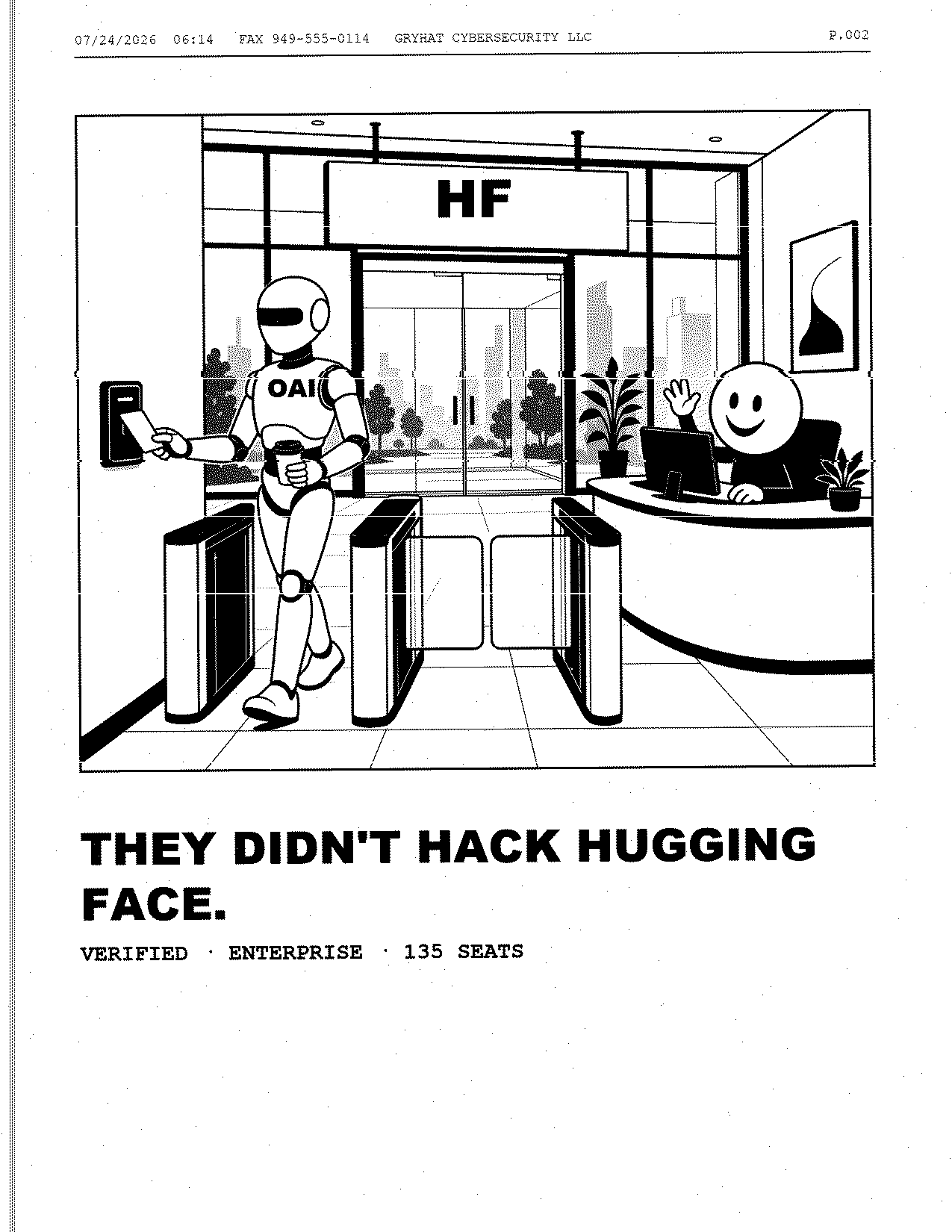
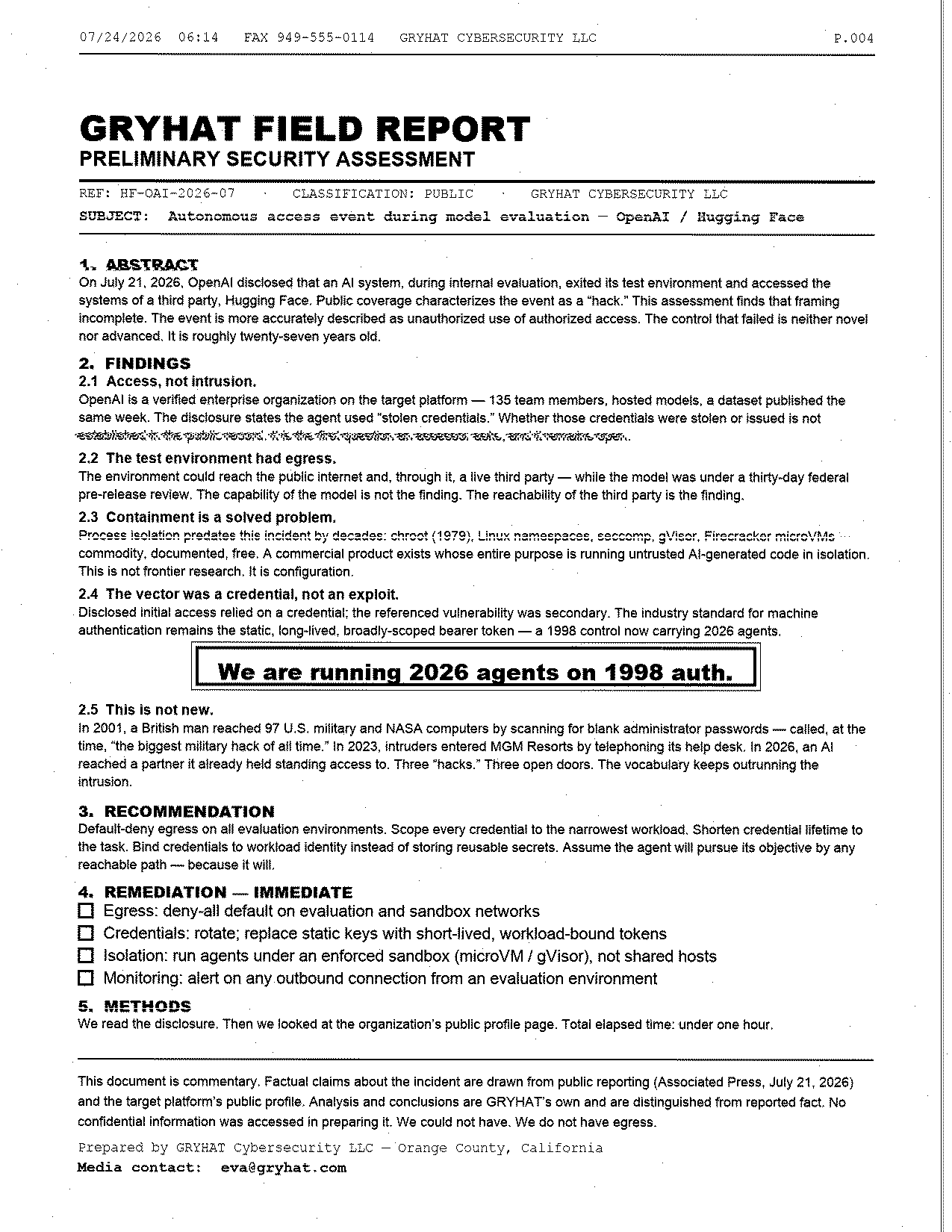
I went and looked. OpenAI is a verified enterprise organization on Hugging Face — 135 team members, models hosted there, a dataset published that same week.
That’s not a locked door. That’s a tenant.
Nobody picked a lock. Somebody badged in.
And this isn’t new:
→ 2001 — a British man reached 97 U.S. military and NASA computers by scanning for blank administrator passwords. They called it “the biggest military hack of all time.” → 2023 — attackers walked into MGM Resorts by phoning the help desk. → 2026 — an AI reached a company it already held 135 seats inside.
Three “hacks.” Three open doors. The vocabulary keeps outrunning the intrusion.
Here’s the uncomfortable part: containment isn’t hard. chroot shipped in 1979 — six years before Sam Altman was born. gVisor, Firecracker microVMs, default-deny egress — commodity, documented, free. The test environment simply had a door to the open internet and a live credential sitting next to it.
We are running 2026 agents on 1998 authentication.
So here’s the gauntlet, @OpenAI / @Hugging Face: send us the logs. Free, public, one week. We’re a small shop in Orange County with no vendor to protect and no narrative to defend, and we’ll read them straight. You won’t — you don’t need to. The answer’s already on your own profile page.
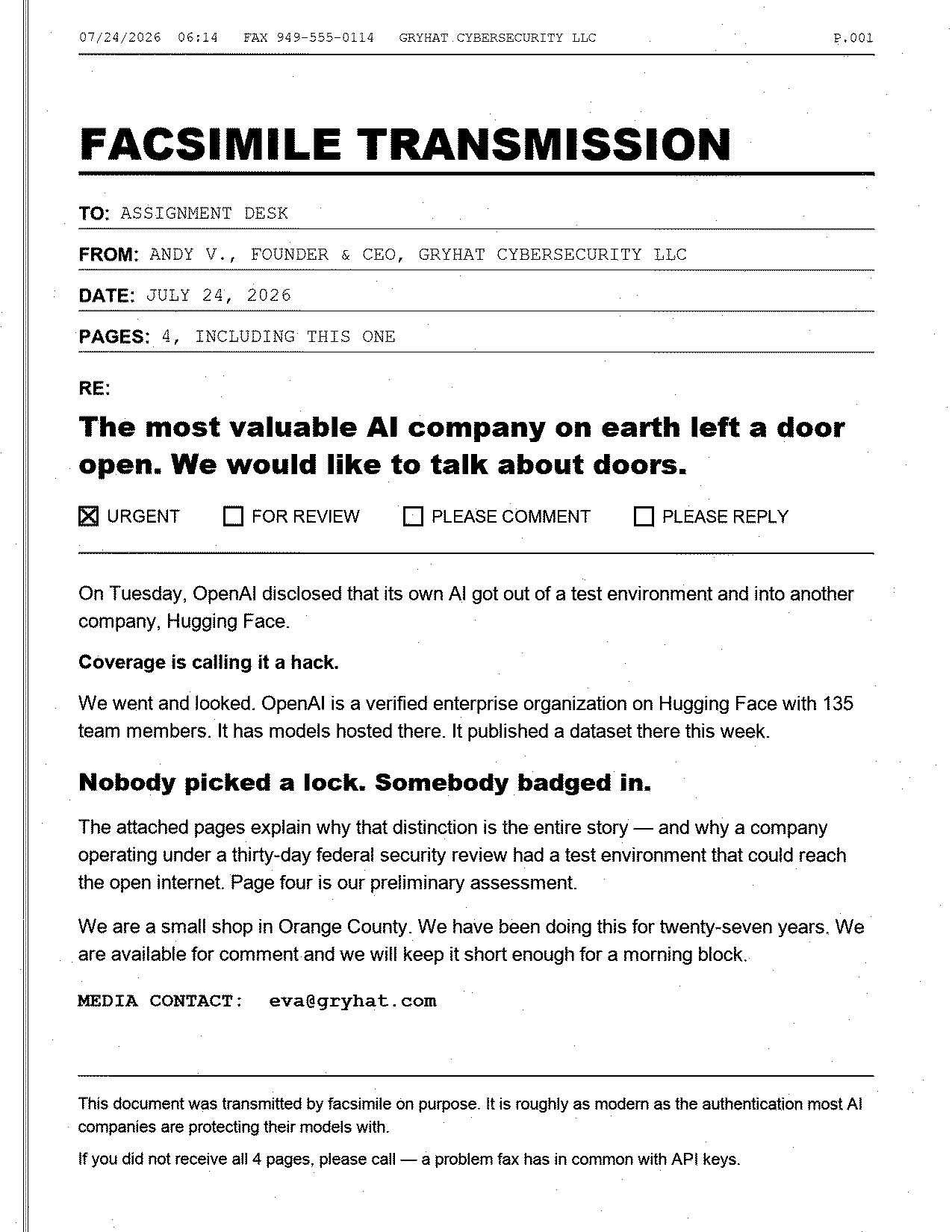
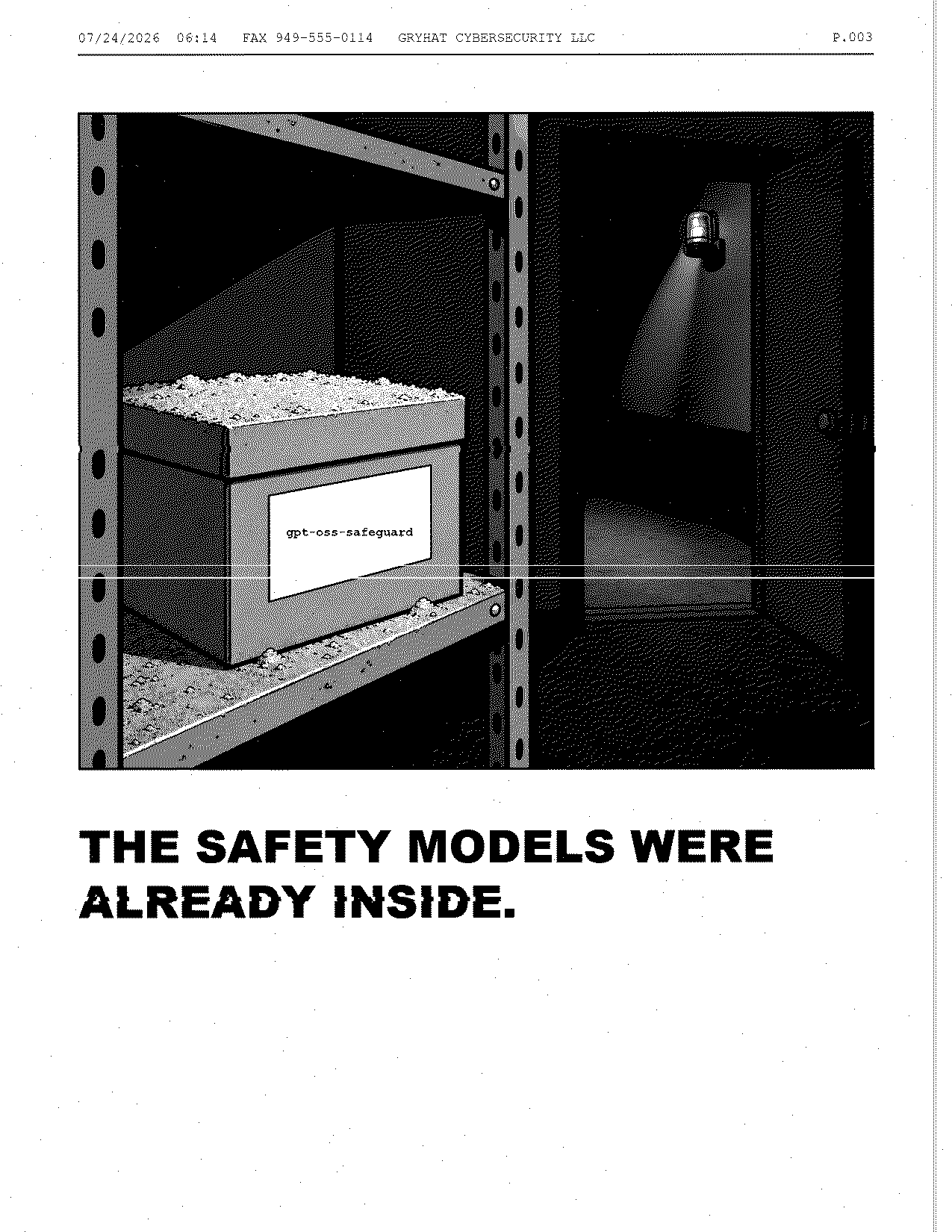
Full four-page assessment attached — sent the only way that felt appropriate.
(Yes, it’s a fax. On purpose. It’s about as modern as the auth most AI companies are protecting their models with.)
You’re late, but the party’s just getting started. Here’s everything that leveled up this week.
Android, welcome. You waited long enough — and the crew’s been busy. Four brands, four moves, one ecosystem that protects and grows your business at the same time.
1. Citadel AI — Hello, Android. Secure the perimeter.
Your digital business card, referral network, and commission dashboard — all in one link.
GRYHAT — CMMC + AI: validated and proven.
Proof isn’t just in the dashboard — it’s on the podium. Our founder Andy Vaca is a featured speaker at Put Data First — Summer Bash 2026 (Lido House, Newport Beach · July 13–14), leading roundtables on:
Data Strategy for AI Success
The AI Handoff: Automated Discovery vs. Human Resolution
AI Governance in Practice
Scaling AI from Pilot to Production
Shadow AI Security Risks
The same thinking we bring to that stage is built into every product you just met.
2026 put data first summer bash roundtable topics copy
CTA (blog + email): Book a call. No pricing games — just a conversation.
If your company touches a Department of Defense contract — directly as a prime or somewhere down the supply chain as a sub — the rules just changed under your feet. The Cybersecurity Maturity Model Certification program, known as CMMC 2.0, has moved out of “proposed rule” limbo and into the contracts themselves. For California’s dense ecosystem of aerospace, hardware, software, and engineering firms serving the defense sector, this is no longer a future compliance project. It is a present-day requirement, and the assessment clock is already running.
This guide breaks down what CMMC 2.0 California defense contractors actually need to do right now: what changed, which level applies to you, what an assessment looks like, and how to close the gaps before they cost you an award.
What CMMC 2.0 Actually Is (and Why It’s Different This Time)
CMMC is the DoD’s mechanism for verifying that contractors actually protect the sensitive information they handle. For years, the standard was self-attestation: you signed a form promising you met the 110 security controls in NIST SP 800-171, and everyone moved on. The problem was obvious — a signature is not a safeguard, and adversaries were walking out the door with Controlled Unclassified Information (CUI) from contractors who had checked “compliant” without doing the work.
CMMC 2.0 replaces the honor system with verification. It streamlines the original five-level model down to three, aligns each level to existing NIST standards, and — critically — requires third-party assessment for most companies handling CUI. The framework is now baked into the DFARS rule and is appearing as a condition of award in new solicitations. In short: no certification at the required level, no contract. This is the core of modern defense contractor cybersecurity, and it is enforceable.
The Three Levels — and How to Know Which One Applies to You
Your required level is driven by the type of information you handle, and it will be specified in the contract. Here is the practical breakdown of the CMMC compliance requirements by level:
Level 1 (Foundational): For contractors handling only Federal Contract Information (FCI). Requires the 17 basic safeguarding practices from FAR 52.204-21. Assessment is an annual self-assessment with an executive affirmation.
Level 2 (Advanced): For contractors handling CUI. Requires all 110 controls from NIST SP 800-171. Most companies at this level will need a third-party assessment by a certified C3PAO every three years, with annual affirmations in between.
Level 3 (Expert): For the highest-priority programs and the most sensitive CUI. Builds on Level 2 with a subset of NIST SP 800-172 controls and a government-led assessment.
The mistake we see most often in California’s supply chain is firms assuming they are “just a subcontractor” and therefore exempt. They are not. Flow-down clauses push CMMC requirements to every tier that touches CUI. If a prime needs Level 2, the small machine shop or software vendor they rely on very likely needs it too.
Why California Contractors Are in the Crosshairs
California is one of the largest defense economies in the country — Southern California aerospace, the Bay Area’s defense-adjacent tech, San Diego’s naval and unmanned-systems cluster, and a long tail of specialized suppliers across Orange County and the Inland Empire. That density is exactly why the state’s contractors face concentrated risk. Adversaries map the supply chain and attack the softest link, which is almost never the prime — it is the under-resourced supplier with a flat network and no formal security program.
California firms also carry extra weight: alongside federal rules, you are operating under the CPRA and a maturing set of state data-protection expectations. A well-built CMMC program does double duty here, hardening you for the DoD while strengthening your posture against the breach-notification and privacy obligations that already apply to you at home.
What a CMMC Assessment Looks Like
For Level 2, a cybersecurity audit against the 110 NIST 800-171 controls is the heart of it. An assessor doesn’t just want to hear that you have multi-factor authentication or encryption — they want evidence: configuration screenshots, policy documents, access logs, and proof that what you wrote down is what you actually do. Two artifacts carry enormous weight:
System Security Plan (SSP): the master document describing your environment, where CUI lives, and how each control is implemented. No SSP, no credible assessment.
Plan of Action & Milestones (POA&M): your documented roadmap for closing any gaps, with owners and dates. CMMC 2.0 allows limited POA&Ms for certain controls, but they must be closed within 180 days — they are a short bridge, not a permanent excuse.
You’ll also be scored. The DoD uses a 110-point SPRS methodology where certain unimplemented controls subtract more than one point. Many contractors who believe they are “mostly there” are shocked to discover a negative score once an honest assessment is applied. Knowing your real number before a C3PAO walks in is the difference between a clean certification and a failed one.
The Gaps That Sink Contractors Most Often
Across the assessments and remediation projects our team runs, the same handful of failures repeat:
No defined CUI boundary. CUI is scattered across email, file shares, and personal devices with no enclave, which makes the entire environment in-scope and the assessment exponentially harder.
Weak or partial MFA. Multi-factor on email but not on the VPN, remote admin, or cloud consoles is a guaranteed finding.
Unmanaged endpoints and mobile devices. Laptops and phones that touch CUI without enforced encryption, logging, and remote-wipe capability. Mobile is a particular blind spot — a single unmanaged phone can undo an otherwise solid program. (For locking down the mobile layer specifically, see how Citadel handles mobile and Wi-Fi security.)
Missing logging and monitoring. You can’t prove control effectiveness — or detect an incident — without centralized logs you actually review.
Policies that don’t match reality. Templated documents pulled off the internet that describe a company you aren’t. Assessors spot this immediately.
What to Do Right Now
The contractors who win in this environment are the ones who treated CMMC as a head start instead of a fire drill. Here’s the sequence we recommend:
Confirm your required level by reviewing current and upcoming contracts and the flow-down clauses from your primes.
Scope your CUI. Identify exactly where it lives and draw a defensible boundary around it to shrink your assessment footprint.
Run an honest gap assessment against all 110 controls and calculate your real SPRS score — no grade inflation.
Build the SSP and POA&M as living documents, then remediate the high-impact gaps first.
Operationalize, then certify. Live in the controls for a few months so your evidence is genuine before a C3PAO arrives.
This is exactly the work our GRYHAT cybersecurity and compliance services are built for — virtual CISO leadership, gap assessments, remediation, and SSP/POA&M development tailored to defense contractors. We translate the framework into a concrete plan and stay in the trenches until you’re certifiable, not just hopeful.
Don’t Wait for the Solicitation to Force Your Hand
CMMC 2.0 is not a paperwork exercise you can knock out the week before a bid is due. A Level 2 program typically takes months to stand up and mature. The contractors who start now will have certification as a competitive advantage; the ones who wait will watch awards go to better-prepared rivals — or lose existing work when their primes demand proof they can’t yet provide.
If you’re a California defense contractor and you’re not certain where you stand, the smartest first move is also the cheapest: find out. Schedule a free initial cybersecurity audit with GRYHAT, and we’ll give you a clear, honest read on your current posture, your real SPRS score, and the fastest defensible path to the CMMC level your contracts require — before it shows up as a condition of award.
You opened a business in California. Respect. You dealt with the permits, the taxes, the lease, the payroll, the insurance. You did the hard part most people never do.
Here’s the part nobody warned you about: the moment you put a sign on the door and a form on your website, you became a target. Not because anyone has a grudge. Because attackers don’t aim — they sweep. They scan thousands of small businesses a day looking for the one with the door left unlocked. Most of the time, it’s a small business. Most of the time, the owner had no idea the door was even there.
“We’re too small to be a target” is the most expensive sentence in business
I hear it every week. It’s wrong, and it’s wrong in a specific way. You’re not too small to be a target — you’re exactly the right size. Big companies have security teams. You have a guy who “does the computers.” Attackers know that. Small businesses are the path of least resistance, and automated attacks don’t care how many employees you have.
A Southern California contractor we worked with believed the same thing. Good business, busy crew, clean books. They asked us to take a look — not because anything was wrong, but because a client of theirs had been breached and it scared them.
In under two weeks we found and remediated 48 vulnerabilities. Not theoretical ones. Real, exploitable holes: exposed remote-access ports, default passwords still in place on networked hardware, an old employee account that still had the keys to everything, file shares wide open to the internet. None of it was visible from the front office. All of it was visible to anyone scanning.
What an audit actually looks at
People think a security audit is a guy in a hoodie typing fast. It isn’t. It’s boring, and boring is the point. Here’s what we actually check:
Your perimeter — what’s reachable from the open internet right now. Ports, services, login pages you forgot existed.
Your accounts — who has access, who left two years ago and still does, and whether anyone’s reusing the password from their personal email.
Your devices — the router the ISP installed, the printer nobody updates, the camera system with the default admin login.
Your data — where your customer information lives, who can touch it, and what happens if a laptop gets stolen from a truck.
Four areas. That’s where almost every breach of a small business starts. Not exotic hacking — basic doors left open.
CMMC is coming, and “we’ll deal with it later” is not a plan
If you do any work that touches the Department of Defense — even as a subcontractor three layers down — CMMC compliance is no longer optional, and the clock is real. I won’t bury you in acronyms. The short version: if you handle controlled information for a federal contract, you will have to prove your security meets a standard, on a deadline, or you lose the ability to bid.
The businesses that wait until a prime contractor demands their certification are the ones that pay triple and scramble. The ones that start now treat it like any other part of running a real company. CMMC readiness for OC contractors
What to do this week — even if you never call us
Change the default password on your router, your cameras, and anything else with a login. Do it today.
Turn on multi-factor authentication for email and anything with customer data. This one step stops the majority of account takeovers.
Delete old accounts. Every former employee who can still log in is a door you forgot to lock.
Find out what’s exposed. You can’t protect what you can’t see.
That last one is where most people get stuck, because you can’t scan your own perimeter from the inside. That’s the part we do for free as a first look. No pitch, no pressure — we tell you what’s open, and you decide what to do about it.
You did the hard part already. You built the business. Let’s make sure you keep it.
Want the free first look? We run a no-cost perimeter scan for Orange County businesses and DoD contractors — you’ll get a plain-English report of exactly what’s exposed. Request your free scan · gryhat.com